The Penny Black is a small square of paper from 1840 that still gets collectors, historians and the odd curious travellor a bit obsessed. It was the first adhesive postage stamp used in a public postal system, issued in the United Kingdom on 1 May 1840 and valid from 6 May. Its face value was one penny, enough to send a letter up to half an ounce anywhere within the country, an idea that felt very new at the time.
You will see the stamp described in museum labels, auction catalogues and guide books, usually accompanied by a portrait of a young queen in profile. For travellers interested in postal history, industrial change or just small objects with long stories, the Penny Black is one of those items that rewards a closer look, especially if you are passing through London or other cities with strong philatelic collections.
Postal reform and the road to the Penny Black
To understand why the Penny Black matters, you need to look at the postal system that came before it. In the late 1830s British postal rates were complex and high. Charges depended on distance and the number of sheets of paper, and very often the recipient rather than the sender paid. Poor families sometimes refused letters they could not afford, so people used tricks like coded messages on the outside of envelopes that could be read without paying.
The key figure in changing this was Rowland Hill. Hill pushed a simple idea: introduce a low, flat rate based on weight and make the sender pay in advance. To show payment, his plan used a small piece of printed, gummed paper that could be stuck to the letter. It sounds obvious to us, but at the time it was a genuine shift in how the post worked.
After a period of public debate and trials, Parliament accepted Hill’s ideas. The Uniform Penny Post came into force in 1840. At the same time, the Post Office prepared new stationery and an adhesive stamp. That first stamp is what we now call the Penny Black. It did not appear in a vacuum; it was one part of a broader attempt to make correspondence cheaper, easier and more predictable for ordinary people.
Design and production: how the stamp was made
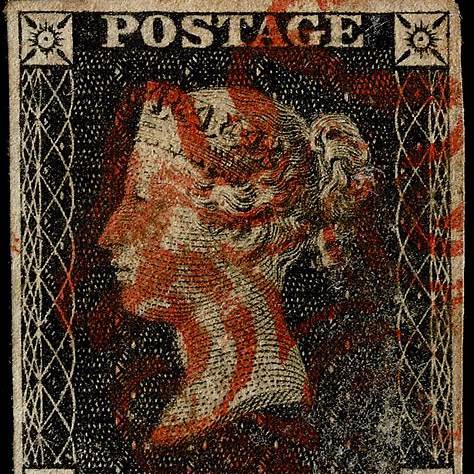
The design of the Penny Black centres on the profile of Queen Victoria, based on a medallion created by engraver William Wyon a few years earlier. The queen faces left, wearing a simple diadem, with the word “POSTAGE” at the top and “ONE PENNY” at the bottom. The background is filled with fine engine–turned lines, both decorative and practical: they made forgery harder.
Printing was handled by the security printers Perkins Bacon in London, using line-engraved plates and black ink on gummed paper. Each sheet held 240 stamps, arranged in 20 rows by 12 columns. Every stamp on the sheet carried a different pair of corner letters, from AA in the top left to TL in the bottom right, which helped show its position on the sheet and, again, made counterfeiting more difficult.
One detail that often surprises people today is that the stamps were imperforate. There were no rows of holes between stamps. Post office staff cut the sheets by hand using scissors or knives. As a result, margins are a big deal for collectors. Many surviving examples have one or more sides cut right up to the design or even slightly into it. Well centred stamps with four clear margins are much scarcer and command higher prices than roughly cut ones.
Production ran from 1840 into early 1841, using a series of printing plates. The total print run was about 68.8 million stamps, a huge number by the standards of the time, although modern issues run into the billions. The last plate, known simply as Plate 11, produced a relatively tiny quantity and now has near-mythic status in specialist circles.
Using the Penny Black: rates, cancellations and problems
In use, the Penny Black did what Hill wanted. It allowed anyone to prepay postage cheaply, which was good news for growing industrial towns, soldiers posting letters home, and people with family spread across the country.
To stop stamps being reused, post offices needed a cancel that showed clearly when a stamp had already paid for one journey. The result was the “Maltese Cross” cancellation, usually in bright red ink, applied over the queen’s portrait. On covers you often see the black stamp with a bold red cross, a combination that is visually quite striking even for non–collectors.
The system was not perfect. Postal staff quickly found that the red cancel could be cleaned off the black stamp in some cases. There were also complaints that the black design was hard to see on dark paper or in poor light. By 1841 the Post Office had decided to make changes. They switched the colour of the one penny stamp from black to red brown (the Penny Red) and the cancel from red to black, a combination that proved more practical.
Because the Penny Black was only in use for about a year, and because so much mail moved through the system, it gives a compact snapshot of mid-Victorian correspondence. Letters bearing the stamp travelled with merchants, colonial officials, and early tourists, as railways cut travel times and people grew more mobile across the British Isles.
Rarity, survival and current values
With nearly 69 million printed, you might expect the Penny Black to be very rare now, but that is not quite right. Many people saved examples, even at the time, and estimates suggest that perhaps around five percent of the original issue survives in some form. That still means well over a million stamps in collections or dealer stocks.
What really affects value is condition and context. A worn, heavily cancelled stamp with tight or cut-into margins might sell for the price of a modest dinner. A crisp example with four wide margins, light cancel and no faults can cost several hundred pounds or more. Unused Penny Blacks, especially with original gum, move into much higher price brackets, and exceptional covers — complete letters with their original stamps intact — can reach six or even seven figures when they have early dates or special historical links.
Auction headlines also feature one-off items, such as the so-called Wallace document or the earliest known stamped cover, which sit in a different universe from the average stamp in a stockbook. For most collectors or curious travellers, it is more realistic to think in the range of tens to low hundreds of pounds for a decent used example.
Where travellers can see a Penny Black
If you are travelling through Britain and want to see a Penny Black in person, you do not have to hunt very far. The Postal Museum in London, home to the former British Postal Museum and Archive, keeps classic Great Britain issues on display or available in its collections for research, including early sheets and essays. The building is a short walk from other central sights, so you can combine a visit with more mainstream sightseeing without much effort.
The British Library in London also holds the original Perkins “D” cylinder press used for Penny Black printing, along with important philatelic collections, some of which are exhibited in its permanent Treasures gallery or special exhibitions. You are looking at the machinery that pumped out millions of those little black squares, which gives a very physical sense of the volume involved.
Beyond London, major national museums and some regional collections around the UK and abroad often include at least one Penny Black in displays on communication, design or Victorian life. Dealers’ shops and stamp fairs can be another way to see them up close, though there the focus is on trade rather than interpretation. If you already travel for business to cities like New York, Frankfurt or Hong Kong, large philatelic auctions held there sometimes exhibit high-grade examples before sale, open for public viewing.
Collecting today: buying, caring and staying realistic
For a lot of people the Penny Black is their first flirtation with philately. The idea of owning “the first stamp” is attractive, and dealers know it. If you are tempted while travelling, it pays to go in with clear expectations.
First, a Penny Black is historic, but it is not generally rare. That’s helpful, because it means you do not need a millionaire’s budget, but it also means there are plenty of tired, repaired or mis-described stamps on the market. Buying from established dealers or auction houses with decent reputations reduces the risk.
Second, pay attention to the basics collectors care about. Centring, margins, the clarity of the Maltese Cross cancel and the absence of thins or tears all matter more than the romantic idea attached to the stamp. If you just want a visible souvenir, a cheaper example is fine. If you find yourself bitten by the bug, you might start hunting for better plates, prettier crosses or interesting covers.
Finally, treat the stamp sensibly once you own it. That means keeping it in a stock card or album away from direct sunlight and damp; not taping it to a scrapbook page; and not trying to “improve” it by cleaning or trimming. Bring home the small story behind the item too. When you look at that tiny black square later, you are seeing a trace of the moment when sending a letter stopped being a luxury and started to become part of everyday life.